
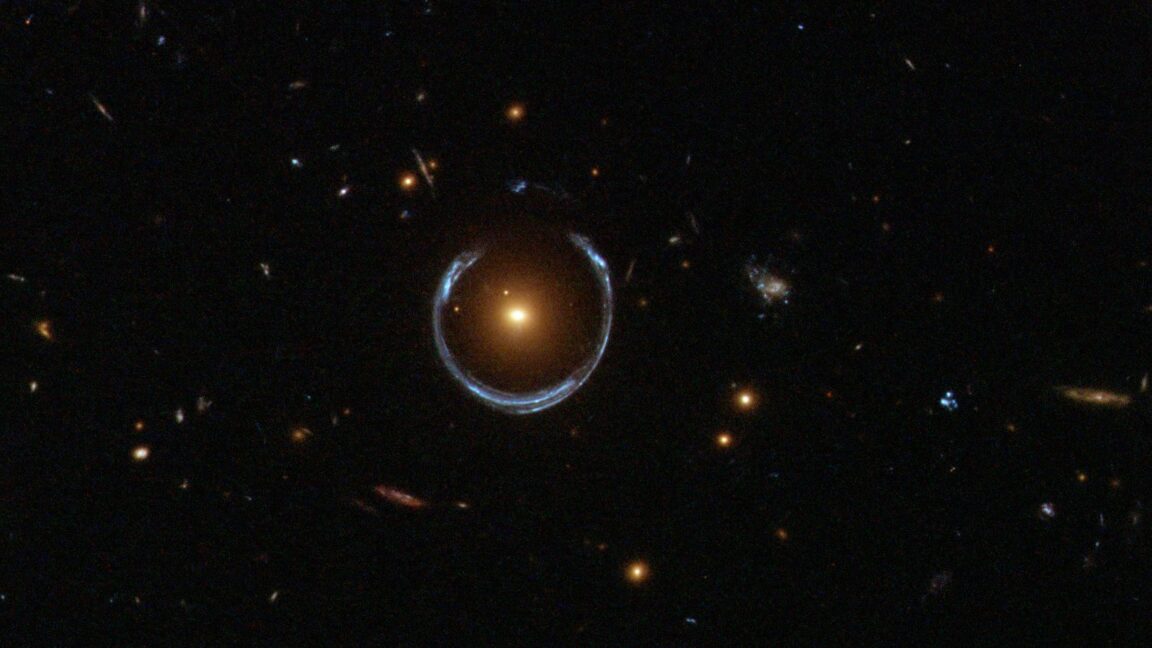
Dive into the groundbreaking discovery of a Saturn-sized exoplanet found lurking in the 'Einstein Desert' – a theoretical blind spot in planetary detection. Learn how gravitational microlensing unveiled this hidden world and what it means for our understanding of planet formation.
Introduction: Peering into the Cosmic Abyss
For millennia, humanity has gazed at the stars, wondering what hidden worlds might lie beyond our solar system. The last few decades have turned that wonder into scientific pursuit, revealing thousands of exoplanets with increasingly sophisticated detection methods. Yet, even with our advanced tools, vast swathes of cosmic real estate and specific planetary types remained elusive, particularly in what astronomers aptly term the 'Einstein Desert'. This theoretical void, a tricky patch in the cosmic tapestry of detection parameters, has historically proven challenging for even the most powerful telescopes and algorithms. Until now. The recent discovery of a Saturn-sized planet, MOA-2016-BLG-227Lb, nestled within this very desert, marks not just another exoplanet finding, but a profound triumph for gravitational microlensing and a significant step forward in mapping the universe's true planetary population.
- The 'Einstein Desert' is a specific range of mass ratios for planet-star systems, making detection via microlensing incredibly difficult.
- Gravitational microlensing is a powerful, yet technically demanding, method for spotting distant and often otherwise invisible worlds.
- The discovery suggests that gas giants in wider orbits might be more common than previously thought, altering our planetary formation models.
The Enigmatic 'Einstein Desert': A Theoretical Blind Spot
Before we celebrate the oasis, let's understand the desert. The 'Einstein Desert' isn't a physical region of space, devoid of stars or galaxies. Instead, it refers to a particular range of planet-to-star mass ratios (specifically between roughly 10-5 and 10-4) where the gravitational lensing signature of a planet is incredibly faint and hard to distinguish from the signal of its host star. When a background star's light is magnified by the gravity of a foreground star (the 'lens'), it creates a characteristic brightening curve. If that foreground star has a planet, the planet's gravity can cause a secondary, smaller 'blip' on this curve. The problem arises when the planet's mass falls into this 'desert' range. Here, the blip is too small to be easily seen, but still significant enough to complicate the primary star's signal, creating a subtle distortion that is notoriously difficult to disentangle.
Imagine trying to hear a whispered secret in a room full of loud conversations. The whisper is there, but the ambient noise drowns it out, or, worse, makes you question if you heard anything at all. This is the challenge faced by astronomers attempting to find planets in the Einstein Desert. The 'noise' comes from the host star's primary lensing event, and the 'whisper' is the planetary deviation. For a Saturn-mass planet orbiting a small star, its gravitational footprint can be precisely in this ambiguous zone, making confident detection a monumental task. For years, this theoretical gap suggested that either such planets were rare, or our detection methods simply weren't sharp enough to find them. The latter, as it turns out, was closer to the truth, demanding innovative approaches to data analysis.
Microlensing: A Cosmic Magnifying Glass for the Invisible
Unlike the more common transit method (observing a dip in starlight as a planet passes in front) or radial velocity method (detecting a star's wobble caused by a planet's gravity), gravitational microlensing relies on the fabric of spacetime itself. Predicted by Einstein's theory of general relativity, it occurs when a massive foreground object (the 'lens', typically a star or a system of stars and planets) passes almost directly in front of a more distant background star (the 'source'). The lens's gravity warps spacetime, bending the light from the source star and effectively magnifying it, causing a temporary brightening as seen from Earth. If the lens star also harbors a planet, that planet's smaller gravitational field creates a secondary, often fleeting, perturbation in the brightening curve – a distinct 'blip' that signals its presence.
This technique is uniquely powerful for finding planets that are very far away, potentially unbound (rogue planets), or those orbiting their host stars at large distances, much like Jupiter or Saturn orbit our Sun. These planets would be invisible to transit or radial velocity methods because their orbital periods are too long or they don't cross our line of sight. However, microlensing events are rare and unpredictable, requiring continuous, wide-field sky surveys. The MOA (Microlensing Observations in Astrophysics) collaboration, operating a 1.8-meter telescope in New Zealand, is one such pioneering effort, constantly monitoring millions of stars in the dense star fields towards the galactic center, patiently waiting for these cosmic alignments.
The Precision of the MOA-2016-BLG-227Lb Detection
The discovery of MOA-2016-BLG-227Lb exemplifies the extraordinary precision and dedicated computational power required for microlensing. During a microlensing event in 2016, the MOA team observed the tell-tale brightening of a background star. While the primary event indicated a foreground star, careful analysis of the light curve revealed a subtle, yet distinct, deviation – the planetary 'blip'. The team, through meticulous modeling and analysis, determined that this blip was caused by a planet approximately 0.6 times the mass of Saturn, orbiting a star that is about 0.2 times the mass of our Sun. Crucially, the planet's orbital distance was estimated to be around 0.82 AU, remarkably close to Earth's distance from our own Sun, yet orbiting a much cooler and dimmer star.
What makes this specific detection so groundbreaking is its success in extracting a signal that, by definition, sits squarely within the notorious 'Einstein Desert'. The researchers had to develop and apply advanced analytical techniques to distinguish the faint planetary signature from the overwhelming primary signal, pushing the boundaries of what was previously thought detectable. It wasn't just about spotting a blip; it was about confidently characterizing a blip that theoretical models had long predicted would be nearly impossible to isolate with current methods. This triumph is a testament to both improved observational capabilities and sophisticated data processing algorithms, effectively creating a map where only uncharted territory existed before.
“This discovery reveals that planets exist in a parameter space that has been a theoretical blind spot. It shows us that nature doesn't avoid forming planets in these 'deserts', and that our observational techniques are finally sophisticated enough to find them.”
Implications for Planet Formation and Distribution
The existence of MOA-2016-BLG-227Lb directly challenges some prevailing assumptions about planet formation and distribution. For a long time, the difficulty in detecting planets in the Einstein Desert led some to speculate that perhaps such planets were simply rare. If they were difficult to detect, and we weren't detecting them, it was a logical (though potentially flawed) conclusion. This new discovery, however, suggests the opposite: these planets might be relatively common, and we just lacked the tools or the finesse to spot them. It indicates that planetary systems with mass ratios corresponding to Saturn-mass planets orbiting smaller stars at moderate separations are likely forming more frequently than our previous observations indicated.
This has profound implications for planetary formation models. Current theories suggest that giant planets, like Jupiter and Saturn, form in the colder, outer regions of protoplanetary disks, where icy materials are abundant. The discovery of a Saturn-sized planet at a distance comparable to Earth's orbit, even around a smaller star, hints at a diverse range of formation pathways or migration mechanisms. It might indicate that gas giants can form closer to their parent stars than previously emphasized in some models, or that they undergo significant orbital migration to reach these positions. Furthermore, if planets in this 'desert' are indeed common, it implies a more robust and efficient planet formation process across a wider range of stellar masses and distances than previously accounted for in some statistical analyses of exoplanet populations.
Beyond the Desert: Future of Microlensing & Exoplanet Hunting
The successful navigation of the 'Einstein Desert' with MOA-2016-BLG-227Lb opens up exciting new frontiers for exoplanet research. This detection proves that the microlensing method, when combined with advanced data analysis, can probe previously inaccessible regions of parameter space. This means future microlensing surveys, such as those planned with NASA's Nancy Grace Roman Space Telescope, will be even more effective. Roman is specifically designed to conduct a massive microlensing survey, which is expected to discover thousands of new exoplanets, including many in the Earth-mass range, and crucially, those lurking in the very 'deserts' that MOA-2016-BLG-227Lb has now shown are populated.
With enhanced sensitivity, wider fields of view, and longer observation durations, missions like Roman will not only find more such planets but also characterize them with greater precision. This will allow astronomers to build a much more complete census of planetary systems, spanning a greater range of masses, orbital distances, and stellar host types. It will help answer fundamental questions: How common are planetary systems like our own? Are gas giants at wide separations a universal feature of planet formation? How does planet formation vary depending on the mass and metallicity of the host star? The ability to systematically detect planets in the 'Einstein Desert' will provide crucial data points to refine and potentially revolutionize our models of how planets form, evolve, and distribute themselves throughout the Milky Way galaxy, offering an unparalleled view into the diversity of cosmic habitations.
Conclusion: Illuminating the Unseen Worlds
The discovery of a Saturn-sized planet in the 'Einstein Desert' is more than just another entry in the ever-growing exoplanet catalog. It is a testament to human ingenuity, pushing the boundaries of what is observable and confirming the universe's boundless capacity for hidden wonders. By successfully detecting MOA-2016-BLG-227Lb, researchers have not only filled a theoretical void but also demonstrated the profound power of gravitational microlensing to illuminate unseen worlds. This breakthrough promises a richer harvest of exoplanet discoveries in the years to come, especially as next-generation telescopes join the hunt, armed with the knowledge that even the most formidable 'deserts' can indeed harbor life – or at least, the raw materials for it in the form of gas giants. The universe, it seems, is even more densely populated with planets than we previously dared to imagine, and the 'Einstein Desert' is now one step closer to becoming a thriving cosmic metropolis, waiting to be explored.